Showing posts with label robins. Show all posts

Friday, December 23, 2022

Christmas scraps, a new year, and a big garden birdwatch . . .


The robin, Erithacus rubecula, is synonymous with Christmas time, and Britain's favourite bird. (Photo from personal collection)


Christmas is practically here, and a brand new year will soon follow. And with that new year, as every good, nature-loving boy and girl knows, comes another Big Garden Birdwatch, here in the UK.

Run by the Royal Society for the Protection of Birds (RSPB), the Big Garden Birdwatch is one of the largest and well-known citizen science projects in the UK. It takes place every January and its aim is to gather data about bird numbers throughout the UK.

In 2023, the Big Garden Birdwatch will take place during the weekend between the 27th and the 29th of January.

All you need to do is sit in your garden, your local park, or watch the birds that visit your balcony, for an hour. Make a note of which birds you see, and then submit those figures to the RSPB, either through their website, or through the post.

At the end of this blog post you will find a link to the RSPB page where you can sign up for next year's watch. When you sign up, you will be sent a guide to help you identify the likeliest feathered visitors to your garden. You will also receive a code that gives you 20% off and free postage and packaging when you make a purchase from the RSPB online shop.

For the individual taking part in the Big Garden Birdwatch it can be both a calming and an exciting activity. Calming because you must be mindful in your watch, and exciting because you never know which birds might make an appearance!

Unfortunately, many of our gardenbirds are suffering a severe decline, with 38 million birds having disappeared from UK skies in the last fifty years. And that is why projects like the Big Garden Birdwatch are so invaluable. With data about bird numbers throughout the country, it gives conservationists a better idea of how to help different bird species. For example, if one type of bird is doing well in one area of the country but very poorly in another, it provides a starting point for figuring out the variables that might determine that bird's success or failure.

So, it's worth checking out that link at the bottom of this post!


So, in the meantime, throughout this festive season of the year, before we reach the Big Garden Birdwatch, what can bird-loving boys and girls do to maintain their place on Santa's nice list?

He does check those lists twice, you know!?

Well . . .


For those of us tucking into a hearty Christmas lunch, and other festive foods, there are often scraps and leftovers to deal with. And the question arises, what to do with them? Sandwiches? Casseroles?

Why not put some of it out for the birds?!


Fats from cuts of meat will be a real treat for some gardenbirds, such as blue tits. However, you must be sure that the fats are unsalted. Birds are practically incapable of metabolising salts, and salt can be toxic to them. It affects their nervous system. So, no salt on the bird food table!


Birds will appreciate a little bread, but it is best to avoid putting out too much because it does not provide much in nutritional value. So, to avoid birds filling up on too much bread, only put out a little. And, if you can, do so with other more nutritional foods available.

When it comes to bread, it is also worth remembering that brown is better than white, and that birds will have an easier time eating moist bread. If bread is stale and dry, give it a little soak for some happy gardenbirds!


If, after Christmas dinner, you like to settle down in front of the telly with a glass of something yummy and a selection of cheeses, don't forget the birds!

They probably won't be interested in what you have in your glass – unless your preferred Christmas drink is a nice glass of clean, fresh water – but some of them will see a nice bit of mild cheese as a real treat. Grate a little mild cheese, put it in your garden, and you might spot a red-breasted robin tucking in with enthusiasm. A perfect Christmas garden scene!


For further details on which garden scraps and leftovers are safe to put out for gardenbirds, please follow this link to the RSPB website.


As well as providing food, it is equally important – if not more important! – to make sure that birdfeeders and birdbaths are clean.

Birdfeeders, attracting wild birds to visit and revisit, can be a hotspot for the spread of parasites and diseases if a decent standard of cleanliness and hygiene is not maintained. 

For this reason, if birdfeeders cannot be cleaned once or twice a week, it is better to not feed birds at all.


To clean your feeders, you will need a bucket, warm water, soap, and materials appropriate for your feeders. For example, sponges or pipe cleaners. Many wildlife charities and animal welfare retailers now sell kits for cleaning birdfeeders. And it is best to look out for those feeders which are made to accommodate the hygiene conscious nature lover when you make your purchase.

I promise, it is worth that little bit of effort to give the feathered visitors to your garden a better shot at a healthy life, free from diseases.

Diseases like trichomonosis, a horrible affliction that causes lesions in the throats of infected birds, are often spread through feeders. And it seems terribly sad, to this humble nature blogger, that those who might have the very best of intentions at heart might be doing a great deal of harm instead.

Please, clean your feeders.


For more information on good hygiene practices for your birdfeeders, please follow this link.


And, if you have done all that, you might expect a good variety of birds to visit your garden during the Big Garden Birdwatch of 2023.

However, if you've no garden of your own, you can also watch birds that visit balcony feeders, or you can watch the birds that visit your local park.

If you've an hour to spare during the weekend of 27 – 29 January 2023, sign up for the RSPB Big Garden Birdwatch here!


Oh, and before I forget, have a Merry Christmas and a Happy New Year! 

And for those that might be alone, or unhappy for other reasons this Christmas time, I hope that you find your way, your place, and your people! I wish you well too!


Thank you for reading.

Before you go, can I ask that you please consider supporting this blog and buy a cup of warm Christmas punch for the author here.

If you've bought all your presents, and you've nothing left to give, you can leave a comment, share this posting with friends on social media, and subscribe so you don't miss a post in future.

It is all very much appreciated. 

And, again, thank you for reading, and a Merry Christmas!


Monday, August 22, 2022

Garden birdwatching


One of the suet feeders, which struggled to maintain its form on hot days. (Photo from personal collection)


Ten birds spotted in the garden . . .


1. Pheasant (Phasianus colchicus)

Now and then, a male and a female pheasant visit the garden to peck at seed left on the ground.

The male is striking with his glossy green head and the bare red skin about the eye. The female is a bit duller, with her more uniformly brown feathers and shorter tail.

This gamebird is common throughout Britain's countryside, but it is an ancient introduction from Asia.


2. Common buzzard (Buteo buteo)

Not really spotted in the garden, but circling high above it, with its call like a kitten's meow.

I have seen a few of these birds flying throughout the village, and have been lucky enough to get closer views when out walking, when I have walked beneath one sitting hunched in a tree.

Like other raptors, this bird suffered in the past because of persecution and pesticide, but is recovering.


3. Red kite (Milvus milvus)

Another raptor spotted flying above the garden, this bird was recently very rare, but has been recovering because of careful conservation.

I have heard some speak in fear of this bird, that it might take off with dogs or cats. But, on average, this bird weighs less than an adult chihuahua; it would have to be a desperate Kite for it to attempt an attack on an animal that outweighs it!

A graceful raptor that deserves our respect and awe. 


4. Sparrowhawk (Accipiter nisus)

Now, this bird of prey has visited the garden, and not just flown over.

The male is about the size of a jackdaw, the female larger. The male is grey, with four or five bars on his tail, white underneath with peachy-orange barring. The female is similar but  as mentioned, larger, and the bars across her chest are darker. 

Pesticide poisoning in the past led to huge drops in the Sparrowhawk population, but it has recovered well.


5. Collared dove (Streptopelia decaocto)

First bred in Britain in 1955 in Norfolk, now found throughout Britain and Ireland.

This bird is fairly skittish, but comes in to feed on the ground, sometimes in pairs. It sits atop chimneys, fences, and aerials, calling a who-hooo-ho.


6. Woodpigeon (Columba palumbus)

The largest and most common pigeon. 

A plump bird. It flies across the sky with a few slapping flaps of its wings before it rises and soars in a glide. Like the Collared dove, it comes in to feed from the ground and whatever might have fallen from feeders.

If you have a problem with large pigeons trying to take food from feeders, simply leave a dish of seed on the ground. The smaller birds get access to the feeders and the pigeons will prefer feeding on the ground anyway – win-win!


7. Wren (Troglodytes troglodytes)

One of our smaller birds, I spotted this one flitting in and out of the budleia.

A little, rich brown bird, with its little tail cocked upwards. It prefers dense cover, loving scrubby vegetation. 

A beautiful little bird with a surprisingly loud voice for its size, I was more than pleased to see it in the garden – if I had had a camera I would now be sharing pictures of it perched upon my watering can!


8. Dunnock (Prunella modularis)

Could be confused with a house sparrow at a glance as it shuffles around under garden feeders.

It's plumage is quite like that of a sparrow, but with a blue-grey throat and breast. It often can be seen moving beneath feeders picking up what has fallen from above.

Common but sadly in decline. 


9. Robin (Erithacus rubecula)

The bird made famous by its association with Christmas time, and often considered the nation's favourite bird.

A common resident bird. 

Perhaps thought of, with its red-breast and melodic song, as a pretty little garden bird, these birds are very territorial, and disputes between Robin's can be violent.


10. Blackbird (Turdus merula)

We finish with another bird familiar to British gardens, with its lovely song. 

The males are black, a small ring of yellow around the eye, and an orange-yellow bill. Females are a dark brown, with a lighter throat, and slight streaking on the chest. 

The song of the blackbird is always a welcome melody.


Thank you for reading. My RSPB Pocket Guide to British Birds is always in my pocket when I am out in the garden or rambling footpaths, and I very much recommend it. 

This blog is not affiliated with the RSPB in any official manner, but I do believe in the work they do.


If you would like to support this blog, you can buy the author a coffee here, and/or, you can like, comment, share, and subscribe.

Thank you again!


Tuesday, March 1, 2022

Who else loses time in nature?


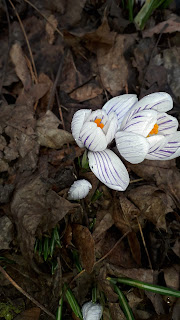
Crocus in the park. (Photo from personal collection)


I took a stroll into town, decided upon a visit to the museum. An exhibition of work created by artist Arabel Labrusan had caught my eye, but my eye is always ready to be distracted by nature and wildlife. And my eyes, and ears, were most definitely distracted.


Around the museum are gardens, where my attention was first drawn to the snowdrops (Galanthus nivalis), and then the daffodils (Narcissus pseudonarcissus); signs of coming spring. I lowered onto my haunches, trying to get a half decent picture of some flowers on my phone. The flowers are a natural reminder that everything passes, capturing their image a futile attempt at holding onto the beauty a while. Then, there are those of us that insist upon sharing that beauty, in spaces like this one.

The snowdrops stood, their perfect little white heads downward turning, looking like melancholy figures. The daffodils, by comparison, seemed happier with their open yellow faces. The trumpets, tending toward a richer and deeper yellow than the paler tepals, could have been calling out gloriously for coming spring. But, of course, that's just the romanticising anthropomorphising side of my love for nature.


A host of golden daffodils? No vale and hill, but in a museum garden. Bedford, Bedfordshire. (Photo from personal collection)

After the sights, it was the sounds, the bird calls and songs, and in following them I saw that I was surrounded by activity. Blackbirds (Turdus merula) were out, collecting materials and food, a number of them present in the garden. They rootled in amongst fallen leaves, and picked at things invisible to my eye on the grass. One, a female, with her feathers earthier than the coal coloured males, had a little trouble with a piece of material she had collected. A long and stringy looking piece of plant material, longer than it seemed she had estimated, she looked to be having some difficulty managing it in her bill.


I stopped, and stood a while, just watching and listening. The Robins (Erithacus rubecula), with their cascading songs, were easy to identify, their music being so present in both town and countryside. And then, there were the tits. A Coal tit (Periparus ater) call caught my ear. Their blue and yellow relatives often visit the feeders at home, but the Coal tits I only see and hear when out in parks and woods. Its calls rang in the gardens of the museum.

In a yew tree, in branches over my head, a brilliant red face, the colour of blood or rose petals. A little song, not as loud as others in the garden, but a pleasant little twittering. A Goldfinch (Carduelis carduelis) perched, its head turning, taking in the scene. On its wings with golden-yellow bars, it flew from the evergreen to a small bare tree, and stayed briefly on a branch before taking off, and away.


Long-tailed tits (Aegithalos caudatus), a pair at least, flitted from place to place, and a grey squirrel (Sciurus carolinensis) sat in a fig tree. Every feathered and furred life was out, busy in search of food and materials, the season for breeding almost here. The Goldfinch returned to the yew tree, something in its bill. When I saw another Goldfinch in the tree, I fancied that they were building their nest, setting up a home for imminent spring.

The various chirps, twitters, and pit-chu calls and songs carried on the air. From treetops and shrubbery, from the Blackbirds rootling around in leaves and other plant matter, tossing unwanted things aside, the sounds of nature and wildlife. People walked about. But, for a little while, the lives of these little birds seemed so much more interesting. As did the only briefly present flowers. I was lost in the purity of it all.


I didn't get into the museum, so lost I was in the birds and flowers. Nature and wildlife are like alien abductions; you can get taken away by them, and return having lost time without realising. Still, I suspect that visits to nature are more pleasant than the abductions. And much easier to believe in too.

I don't mind getting lost in nature, in parks and gardens and woodland, and I don't mind being distracted by the sights and sounds of wildlife. Sometimes even the smells. In fact, I hope that for a long time yet I am still lost and distracted, because when I am not I will have lost something pure. Something not influenced by practical day-to-day desire and needs, something that was there in childhood, and which has run like a thread through my life into adulthood. The thing that inspired Wordsworth. Yes, I hope that I am easily distracted a long time yet.


Thank you for reading. Before you go, can I ask that you consider supporting this blog with a coffee from ko-fi.com - the caffeine does, sometimes, get me where I mean to go!

I resist allowing ad space in this blog, preferring to generate greater things than sales in this place. Or, at least, hoping to generate greater things. But, with writerly ambitions, I seek support for my writing by throwing myself on the kindness of readers.

If you are able to do so, take a look at ko-fi.com - the price of a coffee can be a boost. And, I thank you, every reader and supporter!


Sunday, January 30, 2022

My RSPB Big Garden Birdwatch 2022


The nationwide results of the RSPB's Big Garden Birdwatch at the time I entered my own results (Image is a screenshot of RSPB webpage)

Friday, 28 January, 2022

I didn't sleep well the night before, but I still found myself awake not long after sunrise. And so, with the day free before me, and well aware that this weekend is the weekend of the RSPB Big Garden Birdwatch, I took myself from my bed and dressed. I dressed in the layers that I thought a January morning, the sun not long risen, would demand. I took up a notebook, a pen, and my pocket guide to British birds, just in case I saw something unfamiliar.


It became apparent as I settled in the garden that I was right to wear my layers and my warm winter hat; the cold biting at my nose, my fingers, and even my toes - I had decided on my Converse canvas sneakers for footwear, not very sensibly perhaps.

I sat upon a rolled up cheap blanket, the kind you might use for the beach or a picnic, in a corner of the garden where I thought myself least conspicuous to the birds. And I sat, waiting and watching, with my notebook in my lap. To my left, the sun was still low in the sky, climbing.

The lawn was in front of me, the ivy choked borders at the edges. When I turned my head to my right, slowly and with as little noise as I could, my eyes fell on the birdfeeder station, standing about twenty feet away. Suet and seed mix. A window feeder stuck on the french doors holds seed mix too. When I turned my head to my left, I saw the porcelain feeder, shaped like a hollow cactus, hanging amongst the ivy, suet pellets inside. 


My cactus feeder (Image from personal collection)


The first birds I see are House Sparrows (Passer domesticus),a bird that has undergone a decline and is now on the 'Red List' of endangered British birds. I recall seeing them in greater numbers last year, when I did Big Garden Birdwatch 2021. But that might be because I did the survey later in the day last year. And I was better concealed then too. I know that we have quite a few House Sparrows visiting the garden - we see them all the time.

A male House Sparrow sat on a slender branch, one rising above the ivy, and gave a few chirping and chattering calls. And I listened, suspecting that he might have seen me, and be chattering about my presence. Three females had flown into the ivy, but they seemed to be remaining silent.


As I sat, I could hear other birds too. I heard a Robin before I saw one, its melody familiar and a favourite. And, when the Collared Dove flew in, it did so with little high pips, before it flew off again with a flap and a fuss.

The Collared Dove (Streptopelia decaocto), we usually see in a pair, but this time it was a solitary visitor. But I could hear the call, even when I couldn't see them. Who-hooo-ho. Who-hooo-ho. Who-hooo-ho.


Collared Dove; scientific name - Streptopelia decaocto (Image from personal collection)


The morning air was cold and clean. It didn't yet carry anything offensive to the senses; none of the thick and greasy takeaway smells; none of the monotonous and heavy bass from music that just seems to go on, and on; none of the screams and whoops from late night party goers; no sirens. Not yet, but it was the weekend, and at least some of that would rear up over the next couple of days.

I miss the countryside, where I grew up.


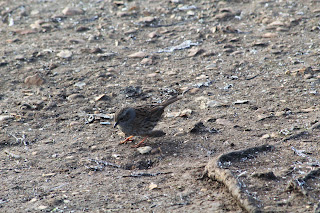
Dunnocks (Prunella modularis) are a regular sight beneath the feeders, and I saw three of them during my Birdwatch. Apart from the Robin, they were the bird least bothered by my presence. There was distance between us, but they did not seem quite as wary of me as others. They just shuffled around on the ground, picking up bits and pieces of food where they found it.


Dunnock; scientific name - Prunella modularis (Image from personal collection)


From the ivy, now and then, came a Blue Tit (Cyanistes caeruleus) or a Great Tit (Parus major). They both seemed to prefer the suet over the seeds, and would visit either the suet log hanging from the feeding station or the cactus feeder containing the pellets. Like the Dunnock, these two birds are regular visitors but, unlike the Dunnock, they are not quite so calm and relaxed in their visits - they flit onto a feeder, take what they need, and flit away.


As the sun kept rising, it got to a point in the sky where, when I turned to my left, the glare from its light blinded me. I shifted my position a little and all was fine.

In the direction of the rising sun, I saw a Magpie (Pica pica) - I think it was the same bird - flying back and forth with twigs in its bill. But, as per the RSPB's instructions about only recording birds that visit, not birds that fly over, I didn't record the sighting.

Some vilify the Magpie, blaming it for declines in the populations of other birds. But there isn't any evidence that this corvid is really responsible for those declines. In fact, a study, referenced on the RSPB website (https://www.rspb.org.uk), "found that songbird numbers were no different in places where there were many magpies from where there are few. It found no evidence that increased numbers of magpies have caused declines in songbirds and confirms that populations of prey species are not determined by the numbers of their predators."

I always believe that, before we condemn a wild animal, we ought to check our own impact and ask ourselves what we can rectify in our own behaviour. When it comes to songbirds, we might endeavour to put back some of the hedgerows and shrubs that have been removed from the countryside. We might volunteer our time at a local nature reserve. We might rewild our gardens a little bit - garden space in the UK is thought to amount to more green space than all the nature reserves, by about three times as much. There is plenty that we can do about our own intense impact upon the habitat and lives of these birds, before making a villain out of the magpie.


The Robin (Erithacus rubecula), the single Robin that I saw this year, came into the garden and visited my cactus feeder. It looked proud and handsome; its orange-red breast full, and containing the promise of song. And it did sing. It sang its melancholy melody, and I was too stupid to understand it, but I loved it anyway.


European Robin; scientific name - Erithacus rubecula (Image from personal collection)


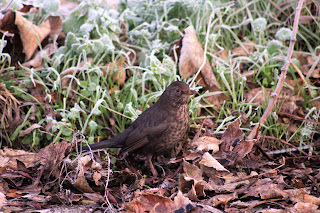
Two female Blackbirds (Turdus merula) visited the garden. One, a little unsure, took itself to the cactus feeder. She flitted around it for a while, eyeing it with caution. Then she flew into the ivy, close to the cactus and still obviously interested in its contents, but still unsure as to how she should make her approach. She went from the ivy, down to the ground, back up into the ivy . . . Eventually, she flew up quickly, from the ground to the cactus feeder, and knocked a suet pellet or two down to the ground. She flew quickly back down to the ground, picked up her reward, and was off, back into the shrubbery.


Blackbird (female); scientific name - Turdus merula (Image from personal collection)


Time passed. The cold that had been biting to start with became numbing. More birds came and went, and I tried to spot each visitor to the garden. Though they moved so quietly, many not arriving with flaps and flutters, but almost silently. 


I don't often watch for birds like this. I prefer to spot birds as I stroll a footpath, rather than sitting and watching for them. But when you do, when you stop and watch for them, it's like meditation.

Some might sniff at the idea of spending an hour like this, just watching and waiting, but that hour didn't stretch and drag. My attention was fixed on my environment and my senses. I was immersed in each and every moment, and I am grateful to each and every visitor that came into the garden. And the others that will come.


My results, submitted to the RSPB's website (Image is a personal screenshot)


I hope that your Birdwatch is a joy. 


Thank you for reading. You can support this blog with a coffee from ko-fi.com - the caffeine keeps my eyes open, when I haven't slept well, so that I can spot birds in the branches! Thank you to all supporters!


Monday, January 3, 2022

Who else thinks this little bird is the star of winter?


A robin red breast. Scientific name: Erithacus rubecula. (Photo from personal collection)


Winter days in this small countryside village where I grew up are short and bracing. The sky is a cold sheet of blue, grey, and white overhead. Almost every public footpath here is a track of churned up dark and wet mud, dark and dead leaves  littering the way where the routes are tree-lined. January - the start of a new year; the festive season is on the wane and, hard as it might be to believe right now, in a couple of months, spring will be blooming and buzzing across the country.


When trying to find my footing - and not slide on to me bloomin' arse - as I have made my way down some of those slippery and muddy paths this winter, I have looked forward to the warmer months. "Oh," I think to myself, "In the summer months, hopefully, paths like these will be baked hard, and much easier to walk on!" And I am not the only one that appreciates the warmer months. The spring and summer are a time of life and abundance, when not only native animals exploit what nature has to offer, but visitors from distant lands make their way here too.

There is one little native bird though, a national favourite, that has become the star of winter. So much so, that it features on the cards and decorations that we use to celebrate our festive season. The little robin red breast.


When out walking today - through village, fields, and woodland - it's the song of the robins that dominates from trees and hedges. That brief bright and light flow of notes. Then a pause. And then another robin responds from somewhere with its own pretty little pattern. And I stop, underneath a tree, and try to find the singer up there, somewhere, amongst the bare branches. I gaze up, my eyes searching and ears listening, too stupid to understand what is being said, but in awe of the little bird anyway. Because, oh, that something so small can make a sound like that!


On another path, one of those country paths that are really just a stretch of mud with a few ankle deep puddles thrown in for variety, I spot another robin perched on a twig protruding form the hedgerow. It is only a few feet in front of me. I can see it quite clearly and it must be able to see me, as big and graceless as I am. But I stand still, and I just watch. It's a quiet path and there isn't much else to disturb the robin, so it just perches there, a few quick movements of its head and feathers, watching me back, I suppose. The bird doesn't fly away like others might - the robin is a brave little thing - and so I make the first move, trudging off along the path, and the bird flits deeper into the hedge.


(Photo from personal collection)


The robin has earned itself a reputation as the gardener's friend, the little bird that will sit atop the gardener's spade and wait for the chance to pick up fat little grubs from overturned soil. And there are plenty of videos out there, floating around on social media, of robins flying into the hands of bird lovers, attracted by a handful of seeds or nuts. I find them to be friendly and attractive little birds. They are definitely worthy of being a national favourite and, in my opinion, they are one of the stars of winter. For giving us beautiful song, even in these cold months, if for nothing else.


For more information on the robin, you can visit the RSPB website here (and, while you're there, don't forget that the Big Garden Birdwatch is on the way!)


Thank you for reading. You can support my writing with a cup of coffee on ko-fi.com - the caffeine keeps me spotting birds and writing all about them here! Thank you to all supporters!

Citizen science -- for the good of nature

  Holly blue (Celastrina argiolus) -- Butterfly Conservation undertake the Big Butterfly Count every summer, between July and August. (Photo...