Showing posts with label RSPB. Show all posts

Friday, December 23, 2022

Christmas scraps, a new year, and a big garden birdwatch . . .


The robin, Erithacus rubecula, is synonymous with Christmas time, and Britain's favourite bird. (Photo from personal collection)


Christmas is practically here, and a brand new year will soon follow. And with that new year, as every good, nature-loving boy and girl knows, comes another Big Garden Birdwatch, here in the UK.

Run by the Royal Society for the Protection of Birds (RSPB), the Big Garden Birdwatch is one of the largest and well-known citizen science projects in the UK. It takes place every January and its aim is to gather data about bird numbers throughout the UK.

In 2023, the Big Garden Birdwatch will take place during the weekend between the 27th and the 29th of January.

All you need to do is sit in your garden, your local park, or watch the birds that visit your balcony, for an hour. Make a note of which birds you see, and then submit those figures to the RSPB, either through their website, or through the post.

At the end of this blog post you will find a link to the RSPB page where you can sign up for next year's watch. When you sign up, you will be sent a guide to help you identify the likeliest feathered visitors to your garden. You will also receive a code that gives you 20% off and free postage and packaging when you make a purchase from the RSPB online shop.

For the individual taking part in the Big Garden Birdwatch it can be both a calming and an exciting activity. Calming because you must be mindful in your watch, and exciting because you never know which birds might make an appearance!

Unfortunately, many of our gardenbirds are suffering a severe decline, with 38 million birds having disappeared from UK skies in the last fifty years. And that is why projects like the Big Garden Birdwatch are so invaluable. With data about bird numbers throughout the country, it gives conservationists a better idea of how to help different bird species. For example, if one type of bird is doing well in one area of the country but very poorly in another, it provides a starting point for figuring out the variables that might determine that bird's success or failure.

So, it's worth checking out that link at the bottom of this post!


So, in the meantime, throughout this festive season of the year, before we reach the Big Garden Birdwatch, what can bird-loving boys and girls do to maintain their place on Santa's nice list?

He does check those lists twice, you know!?

Well . . .


For those of us tucking into a hearty Christmas lunch, and other festive foods, there are often scraps and leftovers to deal with. And the question arises, what to do with them? Sandwiches? Casseroles?

Why not put some of it out for the birds?!


Fats from cuts of meat will be a real treat for some gardenbirds, such as blue tits. However, you must be sure that the fats are unsalted. Birds are practically incapable of metabolising salts, and salt can be toxic to them. It affects their nervous system. So, no salt on the bird food table!


Birds will appreciate a little bread, but it is best to avoid putting out too much because it does not provide much in nutritional value. So, to avoid birds filling up on too much bread, only put out a little. And, if you can, do so with other more nutritional foods available.

When it comes to bread, it is also worth remembering that brown is better than white, and that birds will have an easier time eating moist bread. If bread is stale and dry, give it a little soak for some happy gardenbirds!


If, after Christmas dinner, you like to settle down in front of the telly with a glass of something yummy and a selection of cheeses, don't forget the birds!

They probably won't be interested in what you have in your glass – unless your preferred Christmas drink is a nice glass of clean, fresh water – but some of them will see a nice bit of mild cheese as a real treat. Grate a little mild cheese, put it in your garden, and you might spot a red-breasted robin tucking in with enthusiasm. A perfect Christmas garden scene!


For further details on which garden scraps and leftovers are safe to put out for gardenbirds, please follow this link to the RSPB website.


As well as providing food, it is equally important – if not more important! – to make sure that birdfeeders and birdbaths are clean.

Birdfeeders, attracting wild birds to visit and revisit, can be a hotspot for the spread of parasites and diseases if a decent standard of cleanliness and hygiene is not maintained. 

For this reason, if birdfeeders cannot be cleaned once or twice a week, it is better to not feed birds at all.


To clean your feeders, you will need a bucket, warm water, soap, and materials appropriate for your feeders. For example, sponges or pipe cleaners. Many wildlife charities and animal welfare retailers now sell kits for cleaning birdfeeders. And it is best to look out for those feeders which are made to accommodate the hygiene conscious nature lover when you make your purchase.

I promise, it is worth that little bit of effort to give the feathered visitors to your garden a better shot at a healthy life, free from diseases.

Diseases like trichomonosis, a horrible affliction that causes lesions in the throats of infected birds, are often spread through feeders. And it seems terribly sad, to this humble nature blogger, that those who might have the very best of intentions at heart might be doing a great deal of harm instead.

Please, clean your feeders.


For more information on good hygiene practices for your birdfeeders, please follow this link.


And, if you have done all that, you might expect a good variety of birds to visit your garden during the Big Garden Birdwatch of 2023.

However, if you've no garden of your own, you can also watch birds that visit balcony feeders, or you can watch the birds that visit your local park.

If you've an hour to spare during the weekend of 27 – 29 January 2023, sign up for the RSPB Big Garden Birdwatch here!


Oh, and before I forget, have a Merry Christmas and a Happy New Year! 

And for those that might be alone, or unhappy for other reasons this Christmas time, I hope that you find your way, your place, and your people! I wish you well too!


Thank you for reading.

Before you go, can I ask that you please consider supporting this blog and buy a cup of warm Christmas punch for the author here.

If you've bought all your presents, and you've nothing left to give, you can leave a comment, share this posting with friends on social media, and subscribe so you don't miss a post in future.

It is all very much appreciated. 

And, again, thank you for reading, and a Merry Christmas!


Saturday, August 27, 2022

More Garden Birdwatching


A view from the garden. (Photo from personal collection)


Following the last post published to Monsta Wild, here's a few more birds spotted in a South east England countryside garden . . .


1. Garden warbler (Sylvia borin)


Image from rspb.org.uk

I spotted one of these nondescript little birds flitting from the hawthorn to the budleia, where it skulked behind the leaves and stems awhile. 

It's a plain little bird which, for me, made identification a tad more difficult – so much easier when the bird has an obvious and distinctive feature, and binoculars would help too. Thankfully, I had my pocket guide with me, and the way that the bird reacted to a Garden warbler call when i played it on my phone confirmed it for me. And gave me a better view.

It was my first time seeing this bird in the garden.


2. Long-tailed tit (Aegithalos caudatus)

Image from rspb.org.uk

In my experience, more likely to spot this bird in woodland, or in the hedgerows that line a field. But they do visit garden birdfeeders. And, oh, there's just something charming about these little birds!

The long-tailed tit is one of Britain's smallest birds, weighing 7-9kg. 

Look out for the long tail after which they are named on your feeders. Otherwise they are little balls of fluff, black and white with peachy colouring on the back, rump, and around the eye.


3. Great tit (Parus major)

Image from rspb.org.uk 

The biggest tit and a regular visitor to birdfeeders. 

At a glance, in its colouring, quite similar to the Blue tit, but the Great tit is quite a bit larger. And look for its solid black cap and the black stripe down its chest and belly.


4. Blue tit (Cyanistes caeruleus)


Image from rspb.org.uk 

One of the more familiar and frequent visitors to the feeders. A national favourite.

Much more likely to visit hanging feeders and raised tables, and rarely visits the ground. 

An always welcome little splash of colour and song in the garden.


5. Magpie (Pica pica)


Image from rspb.org.uk 

Often vilified for it's natural practice of taking eggs from the nests of songbirds when the opportunity presents itself. However, a study undertaken by the British Trust for Ornithology (BTO), commissioned by the RSPB, in which 35 years worth of data was poured over, suggests this vilification is unfair.

The study found that, throughout Britain, the number of songbirds was no different in those areas where there were more magpies to those areas where there were few magpies.

Magpies and small birds have existed side-by-side for the entirety of their existence on the planet, occupying the niches that they do and achieving balance. 

To help songbirds, we might achieve more by planting more shrubs in our gardens, rethinking the intensity of farming practices, and being inclusive of nature as we plan and build our infrastructure.


6. Jackdaw (Corvus monedula)

Image from rspb.org.uk 

Like all corvids, an intelligent and adaptable bird. Also, like other corvids, a target of dislike from some garden birdwatchers.

If Jackdaws visit your garden, and you want to keep them from birdfeeders intended for songbirds, simply offer these corvids a space on the ground to feed. They will probably prefer this to trying to navigate hanging feeders.

Also, consider that jackdaws will eat things smaller birds will ignore – pieces of meat, egg, windfall fruit, and scraps. Of course, only put out as much as you expect the birds will eat, and clean and tidy the area regularly. This ought to be standard practice with birdfeeders though. 


7. Starling (Sturnus vulgaris)

Image from rspb.org.uk 

From a distance, might appear uniformly black, but on closer inspection, this bird is iridescent. White feather tips also give it a speckled appearance.

In colder months, their murmurations are a spectacular natural sight. However, their numbers have declined rapidly in recent years and they now hold a place on the conservation Red List.

I have never seen a spectacular murmuration, and I hope that I, and future generations, don't miss that sight forever.


8. House sparrow (Passer domesticus)

Image from rspb.org.uk 

Another resident that has found it's way onto the conservation Red List.

The male has a black mask and a grey cap, while the females and juveniles are little more drab. 

A quarrel of sparrows in the garden isn't hard to miss; probably heard, if not seen, as they chirp and chatter from shrubs and thickets.


I hope you enjoyed this little snapshot of a birdwatch in an English country garden. And, thank you for reading. You can find the previous list of feathered visitors here.


If you can and would like to support this blog, you can buy the author a coffee here.

However, there is a cost of living crisis hit hard right now, so perhaps you could like, comment, share, and/or subscribe instead.

Thank you again!


Monday, August 22, 2022

Garden birdwatching


One of the suet feeders, which struggled to maintain its form on hot days. (Photo from personal collection)


Ten birds spotted in the garden . . .


1. Pheasant (Phasianus colchicus)

Now and then, a male and a female pheasant visit the garden to peck at seed left on the ground.

The male is striking with his glossy green head and the bare red skin about the eye. The female is a bit duller, with her more uniformly brown feathers and shorter tail.

This gamebird is common throughout Britain's countryside, but it is an ancient introduction from Asia.


2. Common buzzard (Buteo buteo)

Not really spotted in the garden, but circling high above it, with its call like a kitten's meow.

I have seen a few of these birds flying throughout the village, and have been lucky enough to get closer views when out walking, when I have walked beneath one sitting hunched in a tree.

Like other raptors, this bird suffered in the past because of persecution and pesticide, but is recovering.


3. Red kite (Milvus milvus)

Another raptor spotted flying above the garden, this bird was recently very rare, but has been recovering because of careful conservation.

I have heard some speak in fear of this bird, that it might take off with dogs or cats. But, on average, this bird weighs less than an adult chihuahua; it would have to be a desperate Kite for it to attempt an attack on an animal that outweighs it!

A graceful raptor that deserves our respect and awe. 


4. Sparrowhawk (Accipiter nisus)

Now, this bird of prey has visited the garden, and not just flown over.

The male is about the size of a jackdaw, the female larger. The male is grey, with four or five bars on his tail, white underneath with peachy-orange barring. The female is similar but  as mentioned, larger, and the bars across her chest are darker. 

Pesticide poisoning in the past led to huge drops in the Sparrowhawk population, but it has recovered well.


5. Collared dove (Streptopelia decaocto)

First bred in Britain in 1955 in Norfolk, now found throughout Britain and Ireland.

This bird is fairly skittish, but comes in to feed on the ground, sometimes in pairs. It sits atop chimneys, fences, and aerials, calling a who-hooo-ho.


6. Woodpigeon (Columba palumbus)

The largest and most common pigeon. 

A plump bird. It flies across the sky with a few slapping flaps of its wings before it rises and soars in a glide. Like the Collared dove, it comes in to feed from the ground and whatever might have fallen from feeders.

If you have a problem with large pigeons trying to take food from feeders, simply leave a dish of seed on the ground. The smaller birds get access to the feeders and the pigeons will prefer feeding on the ground anyway – win-win!


7. Wren (Troglodytes troglodytes)

One of our smaller birds, I spotted this one flitting in and out of the budleia.

A little, rich brown bird, with its little tail cocked upwards. It prefers dense cover, loving scrubby vegetation. 

A beautiful little bird with a surprisingly loud voice for its size, I was more than pleased to see it in the garden – if I had had a camera I would now be sharing pictures of it perched upon my watering can!


8. Dunnock (Prunella modularis)

Could be confused with a house sparrow at a glance as it shuffles around under garden feeders.

It's plumage is quite like that of a sparrow, but with a blue-grey throat and breast. It often can be seen moving beneath feeders picking up what has fallen from above.

Common but sadly in decline. 


9. Robin (Erithacus rubecula)

The bird made famous by its association with Christmas time, and often considered the nation's favourite bird.

A common resident bird. 

Perhaps thought of, with its red-breast and melodic song, as a pretty little garden bird, these birds are very territorial, and disputes between Robin's can be violent.


10. Blackbird (Turdus merula)

We finish with another bird familiar to British gardens, with its lovely song. 

The males are black, a small ring of yellow around the eye, and an orange-yellow bill. Females are a dark brown, with a lighter throat, and slight streaking on the chest. 

The song of the blackbird is always a welcome melody.


Thank you for reading. My RSPB Pocket Guide to British Birds is always in my pocket when I am out in the garden or rambling footpaths, and I very much recommend it. 

This blog is not affiliated with the RSPB in any official manner, but I do believe in the work they do.


If you would like to support this blog, you can buy the author a coffee here, and/or, you can like, comment, share, and subscribe.

Thank you again!


Monday, April 4, 2022

Finding fledgling garden birds


Fledgling garden birds need less human help than you might think. (Image source: rspb.org.uk)


Spring is the season of young life and life renewed. And as flowers bloom and fruits ripen, butterflies and bees fluttering and buzzing between them, birds raise young in their nests. Some of us might even be fortunate enough to have nests in our gardens. It is a real joy to follow the journey from eggs to fledglings. At a respectful distance, of course.

But I have noticed, every year, concerning posts pop up on social media in spring time. Posts from people who have found a young bird in their garden, a young bird that appears unable to fly. They pluck the little feathered youngster up, pop it in a box, snap a few pictures, and pop a post on social media asking advice. All well intentioned, but, most of the time, not at all needed. Indeed, interfering in this way can be doing more harm than good for the fledgling bird.


When a young garden bird leaves the nest it is not wholly independent. They will have left the nest, literally stretching their wings, but they will not have entirely left the care of their parents. Think of it like this; when a human child leaves home, beginning their journey into independent life, they might still turn up at mum and dad's with a bag of laundry and desiring dinners, as they still figure out domestic life for themselves. In a similar way, young birds will remain in the vicinity of the nest, and the care of their parents, immediately after leaving the nest. This care after having fledged is vital to their survival and ought not to be interfered with, except as the very last resort.

If you find a fledgling in your garden, if you stop back and watch from a distance, you ought to notice that the parents are still coming back and forth with food, and caring for the young bird. There is no need for human intervention in this case. Only if the fledgling appears abandoned and the parents do not return should you seek advice from the RSPCA or a local wildlife rescue. There are some other instances when advice and help ought to be sought too. But only in those instances should interference be considered.


When to intervene

If you find a baby bird out of the nest and it is without feathers or only covered in a nestling downy covering, it has most likely fallen from its nest. Now, you can put the baby back into the nest, but only if you are one hundred per cent certain that you know the nest it has fallen from. Otherwise, call a local rescue or the RSPCA for advice and guidance.

If you find a fledgling that is feathered and otherwise fine but is in a place of potential danger, such as on a well-used path or a roadside, it would be a good idea to pop the baby bird into a safe spot. Underneath a bush or something similar. However, do not remove the bird too far from the spot where you found it, for the parents will be looking for the youngster. If there is no safe spot nearby, again call a local rescue for advice and guidance.

If a fledgling is in your garden, and you are a cat owner, be sure to keep that cat indoors until the fledgling has flown. This ought to take a day or two. If you are aware of cats in your area, you might want to keep an eye on the fledgling. But, again, be sure that any intervention is as limited as possible and does not hinder the parents' care for the young bird. When it comes to domestic cats, I have written a post in the past about how they interact with wildlife; you can read it here.


Some birds, such as Barn owls, would not leave the nest without being able to fly, so if you find a young bird of this species unable to fly, it would be a good idea to call the RSPCA or a local wildlife hospital for advice and guidance. However, generally speaking, interfering with fledgling garden birds ought to be an act of last resort. I know that they look fragile and defenseless, but they are living out a lifecycle that is quite natural to them and intervention from us can do more harm than good.

You can read more about what to do if you find a baby bird in the coming months here, on the Royal Society for the Protection of Birds' (RSPB) website.

Share this post if you found it useful!


Before you go, can I ask that you please consider supporting this blog with a coffee from ko-fi.com - it is a real boost!

Resisting ad space here, wishing to generate conversation rather than sales, the kindness of readers supports this blog. With a small donation, it is a real boost to the research, writing, and editing of this blog that is needed before each post is published. And the topics discussed here remain influenced only by that research mentioned.

If you can, please visit ko-fi.com to support, where you will also find links to other blog posts, other of my writing, and social media.

Monday, February 21, 2022

Hey to any new readers! Here's 10 ways you can help nature . . .


Pond at Hill Rise Nature Reserve, Bedford, Bedfordshire. (Photo from personal collection)

Out of a love for nature and wildlife, there comes a concern, for we all know that it is not doing well. So, in today's post, I offer a list of things that we can do, to give back to the nature and wildlife that give us so much.


1. Put up your bird boxes. But, just before you do, be sure of where they are best situated. You can find a useful guide on the RSPB website; make sure that you have the right nest box for the right species, and that you buy a box suitable for the space you have.


2. Bat boxes. It isn't just the birds that will appreciate boxes. You can make your own - the Wildlife Trusts website has this handy guide - or you can purchase one. Bear in mind, when purchasing nest boxes, to make sure the wood is responsibly sourced. Look out for the FSC label.


3. Create a pond. A pond doesn't have to be a large thing, dug out in the garden. A pond can be made from an old washing up bowl. I intend to make one using a storage box, some sand, pebbles and stones, plant pots, and some oxygenating plants this year. Get creative!


4. Bird feeders and bird baths. There are a great many different kinds of bird feeder out there, for different species of bird, and for the different spaces in which they might be placed. From window feeders to standing feeding stations. And bird baths do not have be big expensive things, they can be easily made with inexpensive items.


My inexpensive, makeshift bird bath, made from a planter dish, bricks, and stones. Just add water. (Photo from personal collection)


5. Support a conservation charity. If you can, give a monthly donation. Or, if you are able to do so, lend your time and volunteer on a nature reserve. Perhaps, if you are on the lookout for nest boxes, binoculars, books, gifts, etc., a favourite charity is selling what you are looking for in their online shop. And, don't forget all the citizen science projects run by these organisations throughout the year. There are a great number of ways to support their hard work!


6. Rewild your garden. In the UK, when you take together all of our gardens, they account for more land area than all the nature reserves we have combined. They can be a vital oasis or connection for the wildlife with which we share our spaces. So, leave the lawn a while or, better yet, turn it into a mini meadow. Perfectly manicured lawns are really just a dead monoculture; why not a sea of waving flower heads and life instead?


7. Practice a little self sufficiency. No need to start living in the woods and making compost out of your own waste just yet. But, maybe we can start growing some of our own food. Just a little. Some fruit plants can easily be grown in pots. We know that the less distance our food has to travel the better it is for the planet. So, if it's just outside our doors . . . Remember to buy peat-free compost.


8. Spaces for the little lives. Just as we put up boxes for the bats and birds, we can provide spaces for insects, arachnids, and mollusca. A log pile is a great space for little lives, with all the dark spaces that they can crawl into for shelter and protection. Then there are bee hotels and bug hotels! You can find the RSPB guide to building a bug hotel here, and their guide to building a bee hotel here.


9. Don't forget the night flyers. As we plan our garden for wildlife, considering the pollinators and the birds, it can be easy to forget the night-flying moths and other nocturnal little lives. I mean, they come out when we're tucked up in bed. But, there are things you can do to support the night time lives too. I wrote more about this last year, and you can read about it here.


I believe this is a Feathered Thorn (Colotois pennaria), which has landed on my leg here. (Photo from personal collection)


10. Share your passion through your skills. As I have joined a number of different nature and wildlife focused groups across social media, I have noticed that people explore their passion in different ways. There are photographers, painters, poets, writers . . . There are a number of ways in which we can make our memories something tangible or physical, something that others can carry with them too. And, hopefully, if we can pass that passion on, it might inspire someone else to get involved.


Thank you for reading. Just before you go, can I ask you to please consider supporting this blog with a coffee from ko-fi.com - the caffeine keeps me doing my part!

I resist ad space here, wishing to generate conversation more than sales, but, with my writerly ambitions, I must seek support from readers. With the research, writing, proofreading, editing . . . that goes into each post, just a small donation can really help.

If you can, please do buy this blogger a coffee over on ko-fi.com, and I will see you again soon. I thank you for reading, it is much appreciated.


Saturday, February 12, 2022

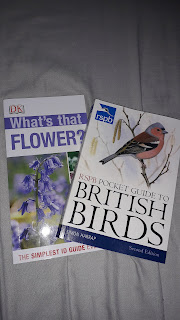
Pocket guides and long rambles


I expect that I shall still be shuffling along countryside paths well into my winter years. I can see it now, a pair of glasses up on my head as I squint at the pages of some pocket guide, dressed in some well worn duffle coat, guide books in one pocket and snacks of some sort stuffed into the other. Perhaps a sandwich wrapped untidily in cling film.

Maybe I will be able to afford a decent pair of binoculars by then!


The two books pictured above are the two guides I make use of most. They supplement my rambles, adding to the wonder I feel, in the presence of the birds and flowers, with the knowledge on every page.

Often, I don't know what I am seeing, hearing, or sometimes even smelling, as I tramp the footpaths. But, with guidebooks like these, I am able to identify what I have seen, which might satisfy my curiosity in itself. And, if it doesn't, it's a great starting point for gathering further information - after identification, I can put a name to what I am looking for!


When I am able to do so, I make a purchase or two from the RSPB Shop. I see it as a win-win situation; they have what I need or want, to bolster my experiences with nature, and in buying from them I am supporting a charity that does great work to conserve the natural world. 

I get great joy and peace out there, by water, amongst the trees, the flowers, the birds . . . and I support anyone that works for the protection of all that.


I am not affiliated with the RSPB in any way, I do not receive any remuneration or commissions for writing about them here. I just believe in the work they do.

You can check out the RSPB's online shop yourself, here, where you can find everything from bird food to books and stationery.

Happy trails!


Thank you for reading. Before you go, I would just like to ask that you consider supporting this blog with a coffee from ko-fi.com - the caffeine helps me focus on the words in my guidebooks!

I write here because of my love for nature and wildlife, and that is what I hope comes across to the reader. So, I have resisted allowing ad space here as much as possible.

On this blog, I may discuss products that I have purchased and make use of, like the guidebooks mentioned above, but these are not paid ads. I am not affiliated with the RSPB - I am not even sure whether or not they have an affiliate programme - and I receive no commission from any clicks or purchases made through the above link.

I just like the Royal Society for the Protection of Birds.

But, with the time and effort it takes to research, write, proofread, edit . . . every post here, I must ask that readers, if they can, consider supporting this blog. A coffee from ko-fi.com really helps. And, thank you, to every reader and supporter!

Tuesday, February 1, 2022

Want an inexpensive birdbath in your garden? Here's how . . .


My rudimentary birdbath (Image from personal collection)


Last Wednesday, with the day free to me and nothing to do, I decided that I would do something for the garden birds. Because, after all, they have brought me so much joy!


My interest in gardening really is driven by passion for nature and wildlife, and I'm afraid that I'm not too bothered if the results aren't aesthetically pleasing. That comes second to whether or not my efforts benefit the wildlife out there. In my book, anyway.

And, I don't think anyone can claim my birdbath is prettier than some of the ornamental ones available in the shops. But I suspect the birds don't mind.


Putting my birdbath together

All I needed to buy was a round plant pot tray. So, I took myself off to a local odds and ends shop - the sort of place that seems to sell a little bit of whatever - and I bought my plant pot plate. It cost me all of a few quid - I can't remember the exact price, but it was less than £3, but more than £2.

At home, I took the plant pot plate into the garden. Before filling it with water, I took myself down to the shed, where I knew I would find some loose bricks - leftover from when work had had to be done on the flat some months back. I took three bricks, and put them beside each other, on their sides, forming a base onto which I could put my bath.

Into the bottom of the tray I put some small stones, that I collected from around the garden, and a piece of broken paving slab. This gives the tray a bit more weight, which means it's less likely to blow across the garden when it's stormy, and it also means that the birds will have better footing. The broken piece of slab also provides a slightly more elevated surface, for those nervous birds that want to check their surroundings.

At this point, after making sure that the tray was stable, I filled the bath from a watering can.


Since putting the birdbath together last week, I have washed it out a couple of times. I squirt some washing up liquid into the water and then use my hands to rub around the tray. After that, I rinse using the watering can, empty the tray, and rinse again. I keep rinsing until the water is no longer soapy.

When the bath has been out for a little longer, I will have to get myself a brush and give it a more thorough scrubbing, I should imagine. Especially in summer, if any algae appears.


Since putting my bath together, I have to admit that I haven't seen it being used yet. But, I am not discouraged. Often with these sorts of things it can be as simple as moving the bath to another spot in the garden. At the moment, it is in a rather open spot, and it could be the birds are hesitant to use the bath when cover is too far away to flit into, should they feel the need.

This bath is easy to move though, the heaviest part of the thing being the bricks.

If you do want to make it look a little prettier, placing some potted wildflowers around it ought to do the trick, which will also attract pollinators as well as birds.


I was inspired to build the birdbath by this page on the RSPB website. I am not affiliated with the RSPB in any official or professional capacity but, of all the conservation charities, the Royal Society for the Protection of Birds is the one to which I refer most often when I am looking for ideas on how I can do a little bit more for nature. I urge you to take a little look at their website and help in any way you can.


I hope you enjoyed the read, and if you are going to make your own birdbath, let me know in the comments! I ask that you please consider supporting this blog with a coffee from ko-fi.com - the caffeine keeps me pottering around in the garden! Thank you to all readers and supporters - you keep me going!

Sunday, January 30, 2022

My RSPB Big Garden Birdwatch 2022


The nationwide results of the RSPB's Big Garden Birdwatch at the time I entered my own results (Image is a screenshot of RSPB webpage)

Friday, 28 January, 2022

I didn't sleep well the night before, but I still found myself awake not long after sunrise. And so, with the day free before me, and well aware that this weekend is the weekend of the RSPB Big Garden Birdwatch, I took myself from my bed and dressed. I dressed in the layers that I thought a January morning, the sun not long risen, would demand. I took up a notebook, a pen, and my pocket guide to British birds, just in case I saw something unfamiliar.


It became apparent as I settled in the garden that I was right to wear my layers and my warm winter hat; the cold biting at my nose, my fingers, and even my toes - I had decided on my Converse canvas sneakers for footwear, not very sensibly perhaps.

I sat upon a rolled up cheap blanket, the kind you might use for the beach or a picnic, in a corner of the garden where I thought myself least conspicuous to the birds. And I sat, waiting and watching, with my notebook in my lap. To my left, the sun was still low in the sky, climbing.

The lawn was in front of me, the ivy choked borders at the edges. When I turned my head to my right, slowly and with as little noise as I could, my eyes fell on the birdfeeder station, standing about twenty feet away. Suet and seed mix. A window feeder stuck on the french doors holds seed mix too. When I turned my head to my left, I saw the porcelain feeder, shaped like a hollow cactus, hanging amongst the ivy, suet pellets inside. 


My cactus feeder (Image from personal collection)


The first birds I see are House Sparrows (Passer domesticus),a bird that has undergone a decline and is now on the 'Red List' of endangered British birds. I recall seeing them in greater numbers last year, when I did Big Garden Birdwatch 2021. But that might be because I did the survey later in the day last year. And I was better concealed then too. I know that we have quite a few House Sparrows visiting the garden - we see them all the time.

A male House Sparrow sat on a slender branch, one rising above the ivy, and gave a few chirping and chattering calls. And I listened, suspecting that he might have seen me, and be chattering about my presence. Three females had flown into the ivy, but they seemed to be remaining silent.


As I sat, I could hear other birds too. I heard a Robin before I saw one, its melody familiar and a favourite. And, when the Collared Dove flew in, it did so with little high pips, before it flew off again with a flap and a fuss.

The Collared Dove (Streptopelia decaocto), we usually see in a pair, but this time it was a solitary visitor. But I could hear the call, even when I couldn't see them. Who-hooo-ho. Who-hooo-ho. Who-hooo-ho.


Collared Dove; scientific name - Streptopelia decaocto (Image from personal collection)


The morning air was cold and clean. It didn't yet carry anything offensive to the senses; none of the thick and greasy takeaway smells; none of the monotonous and heavy bass from music that just seems to go on, and on; none of the screams and whoops from late night party goers; no sirens. Not yet, but it was the weekend, and at least some of that would rear up over the next couple of days.

I miss the countryside, where I grew up.


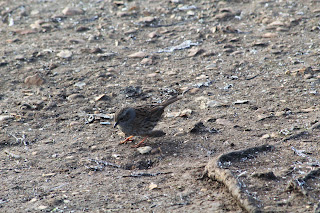
Dunnocks (Prunella modularis) are a regular sight beneath the feeders, and I saw three of them during my Birdwatch. Apart from the Robin, they were the bird least bothered by my presence. There was distance between us, but they did not seem quite as wary of me as others. They just shuffled around on the ground, picking up bits and pieces of food where they found it.


Dunnock; scientific name - Prunella modularis (Image from personal collection)


From the ivy, now and then, came a Blue Tit (Cyanistes caeruleus) or a Great Tit (Parus major). They both seemed to prefer the suet over the seeds, and would visit either the suet log hanging from the feeding station or the cactus feeder containing the pellets. Like the Dunnock, these two birds are regular visitors but, unlike the Dunnock, they are not quite so calm and relaxed in their visits - they flit onto a feeder, take what they need, and flit away.


As the sun kept rising, it got to a point in the sky where, when I turned to my left, the glare from its light blinded me. I shifted my position a little and all was fine.

In the direction of the rising sun, I saw a Magpie (Pica pica) - I think it was the same bird - flying back and forth with twigs in its bill. But, as per the RSPB's instructions about only recording birds that visit, not birds that fly over, I didn't record the sighting.

Some vilify the Magpie, blaming it for declines in the populations of other birds. But there isn't any evidence that this corvid is really responsible for those declines. In fact, a study, referenced on the RSPB website (https://www.rspb.org.uk), "found that songbird numbers were no different in places where there were many magpies from where there are few. It found no evidence that increased numbers of magpies have caused declines in songbirds and confirms that populations of prey species are not determined by the numbers of their predators."

I always believe that, before we condemn a wild animal, we ought to check our own impact and ask ourselves what we can rectify in our own behaviour. When it comes to songbirds, we might endeavour to put back some of the hedgerows and shrubs that have been removed from the countryside. We might volunteer our time at a local nature reserve. We might rewild our gardens a little bit - garden space in the UK is thought to amount to more green space than all the nature reserves, by about three times as much. There is plenty that we can do about our own intense impact upon the habitat and lives of these birds, before making a villain out of the magpie.


The Robin (Erithacus rubecula), the single Robin that I saw this year, came into the garden and visited my cactus feeder. It looked proud and handsome; its orange-red breast full, and containing the promise of song. And it did sing. It sang its melancholy melody, and I was too stupid to understand it, but I loved it anyway.


European Robin; scientific name - Erithacus rubecula (Image from personal collection)


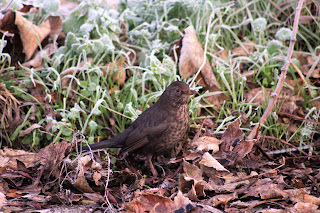
Two female Blackbirds (Turdus merula) visited the garden. One, a little unsure, took itself to the cactus feeder. She flitted around it for a while, eyeing it with caution. Then she flew into the ivy, close to the cactus and still obviously interested in its contents, but still unsure as to how she should make her approach. She went from the ivy, down to the ground, back up into the ivy . . . Eventually, she flew up quickly, from the ground to the cactus feeder, and knocked a suet pellet or two down to the ground. She flew quickly back down to the ground, picked up her reward, and was off, back into the shrubbery.


Blackbird (female); scientific name - Turdus merula (Image from personal collection)


Time passed. The cold that had been biting to start with became numbing. More birds came and went, and I tried to spot each visitor to the garden. Though they moved so quietly, many not arriving with flaps and flutters, but almost silently. 


I don't often watch for birds like this. I prefer to spot birds as I stroll a footpath, rather than sitting and watching for them. But when you do, when you stop and watch for them, it's like meditation.

Some might sniff at the idea of spending an hour like this, just watching and waiting, but that hour didn't stretch and drag. My attention was fixed on my environment and my senses. I was immersed in each and every moment, and I am grateful to each and every visitor that came into the garden. And the others that will come.


My results, submitted to the RSPB's website (Image is a personal screenshot)


I hope that your Birdwatch is a joy. 


Thank you for reading. You can support this blog with a coffee from ko-fi.com - the caffeine keeps my eyes open, when I haven't slept well, so that I can spot birds in the branches! Thank you to all supporters!


Monday, January 24, 2022

RSPB Big Garden Birdwatch 2022


Banner from RSPB website; image sourced from rspb.org.uk

Disclaimer: this blog is not affiliated with the RSPB, I just believe that they do good work.


This weekend, between 28 and 30 January 2022, the RSPB's Big Garden Birdwatch will take place. Volunteers up and down the country will be spending an hour, in their gardens, on their balconies, or in local parks, watching and counting the birds they see. This citizen science project is very useful. It provides a picture of the ups and downs of bird populations throughout the country. I have signed up, and would encourage anyone who cherishes our British birds to do so as well.

There is a wealth of research and studies out there, revealing just how much nature does for us, in a number of different ways. Events like this give us the opportunity to give something back. Be generous, do something mindful, and sign up to take part in this year's Big Garden Birdwatch at www.rspb.org.uk


Falling in love with birds

My childhood home was a wonderful place in a small countryside village. Why is that important? It's important because it was in that countryside village, that countryside home with a little countryside garden, where I fell in love with British birds. Growing up there, I saw a variety of birds visiting the garden. It's there that my fascination for these winged wonders bloomed into being. Yeah. Because they are winged wonders. The tiny little animals, the ones that flitted back to the feeders, that could fit easily in to my human hand, but that face struggles and troubles the likes of which I would never know. Or the raptors, symbols of power and stealth, that could stop me in wonder, my craning upward.

They sang or called to each other, and I just listened and watched; an audience too stupid to understand the song, but in thrall to it nonetheless.


Protecting what we love

According to the RSPB website, the UK has lost 38 million birds in the last fifty years. So it is vital that we do all that we can to understand the state of bird populations from year to year. And where in the country birds are doing well, and where they are suffering. It tells us much. Projects like the Big Garden Birdwatch are necessary!


Our nature and wildlife is often relegated to the bottom of political agendas. We see it time after time. And so it is left to charities, non-profit organisations, and generous volunteers, to do what they can. As time goes on, and the crises that our natural world is facing become more and more apparent, perhaps the more monied and powerful will be compelled to do more. But until that time, a time when more than words and promises are given, maybe, it's still on the campaigners and volunteers and activists to hold back the tide.


In my life, the moments that have been the calmest and happiest have been very clear, like those childhood summers when I would watch birds and butterflies in our garden from the window of my bedroom. 

I can spare an hour to give back to that nature which still gives me those moments of peace and joy.


Taking part

So, this weekend, clean your birdfeeders, fill them with nuts and seeds and suet, and sit for an hour and watch for feathered visitors. Or, take yourself to your local park, with a flask of something hot and a notebook, and find a bench to watch from. 

Wherever you watch from, don't forget to submit your results. Again, you can sign up to take part here.


Thank you for reading. You can support Monsta Wild with a coffee on ko-fi.com - the support means that I can keep writing, so thank you!

Citizen science -- for the good of nature

  Holly blue (Celastrina argiolus) -- Butterfly Conservation undertake the Big Butterfly Count every summer, between July and August. (Photo...